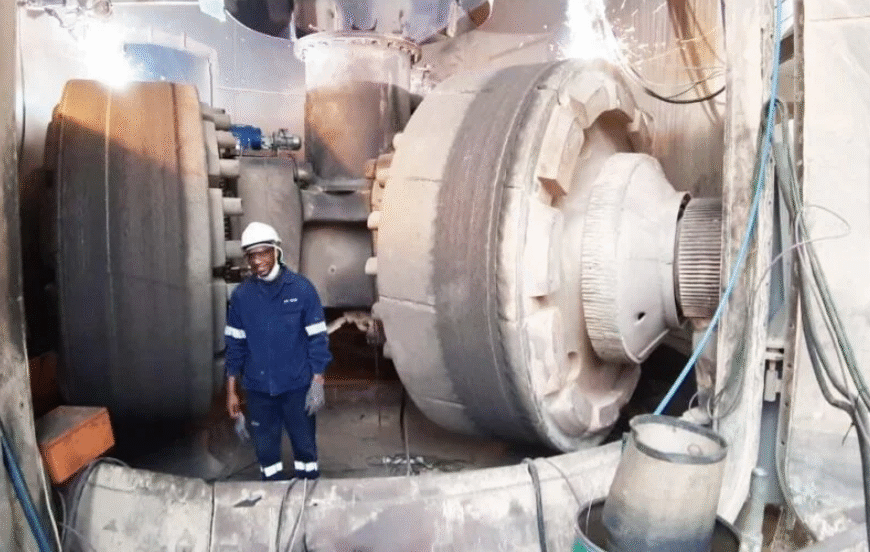

Harsh conditions and manual limits cause costly unplanned downtime and safety risks in heavy industry. Heavy-duty encoder systems solve this by delivering real-time position and speed data, ensuring strict WHS compliance, predictive maintenance, and optimized tons-per-hour output.
Key Takeaways
- Operational Excellence: Encoders optimize machinery speeds, maximizing tons-per-hour output while driving down unplanned downtime costs across critical heavy sectors
- Safety & Compliance: Real-time data streams provide safe-speed monitoring and anti-collision safeguards, ensuring strict adherence to Australia’s WHS Act 2011
- Future-Ready Resilience: IP-rated, ruggedized housings withstand extreme outback conditions, effortlessly integrating with IIoT frameworks to enable predictive maintenance
An encoder system is a sensor that converts mechanical motion into digital signals for position, speed, and direction feedback. It is an essential element in the Australian heavy machinery industries, such as mining, ports, steel, and cranes.
Because these industries demand precision, uptime, and WHS compliance that manual systems cannot guarantee. This blog will list the 10 benefits of encoder systems that are relevant in the heavy industry.
10 Benefits of Using Encoder Systems in Heavy Machinery
The following are the benefits of incremental and absolute shaft encoder systems that help heavy machinery operators control a machine’s position, speed, and direction.
| # | Benefit | Core Impact & Australian Context |
| 1 | Precision Motion Control | Incremental and absolute encoders provide granular position feedback (PPR), ensuring exact restart accuracy for crane hoists and mining conveyors. |
| 2 | Reduced Unplanned Downtime | PLC-driven anomaly detection mitigates costly operational halts across high-stakes Australian mining sectors. |
| 3 | Predictive Maintenance | Streams real-time operational data to IIoT platforms, flagging component wear (e.g., Pilbara iron ore operations) weeks before mechanical failure. |
| 4 | Enhanced Workplace Safety | Drives safe-speed monitoring and anti-collision systems to fulfill strict WHS Act 2011 and Safe Work Australia regulatory compliance. |
| 5 | Greater Operational Throughput | Maximizes equipment rated speeds to directly elevate tons-per-hour output in steel mills and bulk port terminals. |
| 6 | Harsh Environment Resilience | Heavy-duty, sealed magnetic housings (IP65–IP67) withstand intense outback heat, dust, and corrosive port environments. |
| 7 | Lower Total Cost of Ownership | Offsets upfront system capital investments by significantly extending overall machinery service life and lowering long-term maintenance costs. |
| 8 | Seamless IIoT Integration | Supports modern protocols (Profinet, EtherNet/IP) to effortlessly bridge field operations with smart factory and digital mine control architectures. |
| 9 | Electrification & Green Support | Delivers the precise motor feedback necessary to optimize heavy electric haulage drive efficiency, backing net-zero mining targets. |
| 10 | Cross-Application Scalability | Standardizes spare parts management and technician training across multi-site processing plants, drills, and rolling mill fleets. |
Table 1: The 10 Benefits At a Glance
Benefit 1: Precision Motion Control
Encoders, both incremental and absolute types, provide granular position feedback measured in pulses per revolution (PPR). Absolute encoders retain exact position on power-up, critical for crane hoists and mining conveyors where restart accuracy is non-negotiable.
Benefit 2: Reduced Unplanned Downtime
Real-time position and speed feedback enable PLC-driven automation to detect anomalies before failure occurs. In Australian mining operations where unplanned downtime can cost tens of thousands of AUD per hour, encoder-driven monitoring is a core availability strategy.
Benefit 3: Predictive Maintenance Capability
Absolute shaft encoder systems continuously stream,
- speed deviation,
- vibration (typically measured by external sensors),
- overspeed alerts, and
- positional drift data to IIoT platforms.
Pattern changes flag bearing wear, shaft misalignment, or gear degradation before failure. This shifts operations from reactive to predictive maintenance as per Australia’s Industry 4.0 and ‘Future Made in Australia’ manufacturing push.
Benefit 4: Enhanced Workplace Safety and WHS Compliance
Encoders underpin,
- safe-speed monitoring,
- overload detection, and
- anti-collision systems on cranes, conveyors, and hoists.
Under Australia’s WHS Act 2011, operators have a duty to manage machinery hazards. Here, encoder-enabled motion limits and emergency-stop triggers directly support compliance documentation and risk mitigation.
See also: Protecting Your Career From Unlawful Employer Practices
Benefit 5: Greater Operational Throughput
Precise incremental encoder feedback allows machinery to operate at optimal rated speeds without over-engineering safety margins. In steel mills and bulk port terminals, two critical Australian heavy-industry settings, this translates directly to higher tons-per-hour output without additional capital investment.
Benefit 6: Reliable Performance in Harsh Australian Environments
Heavy-duty encoder housings are rated to IP65–IP67 and engineered for extreme temperature ranges. These make them withstand the dust, vibration, and heat typical of Australian outback mine sites.
Magnetic and inductive encoder designs resist contamination that disables optical alternatives. This reduces the failure rate of imported generic encoders that underperform in field conditions.
Benefit 7: Lower Total Cost of Ownership (TCO)
While encoder systems require upfront investment, their impact on,
- extended service life,
- reduced emergency maintenance, and
- improved OEE (Overall Equipment Effectiveness) delivers measurable long-term ROI.
The cost of the encoder system is a fraction of the cost of one major unplanned repair event. It’s better to equip it to avoid future issues in the machinery.
Benefit 8: Seamless Integration with Automation and IIoT Systems
Modern encoder systems communicate via Profibus, Profinet, EtherNet/IP, and CANopen protocols. This enables plug-and-play integration with SCADA, PLCs, and IIoT dashboards.
For Australian operations migrating to smart factory or digital mine frameworks, encoder compatibility with existing control architectures is a practical procurement priority.
Benefit 9: Support for Electrification and Green Operations
As Australian miners electrify haulage and processing equipment in pursuit of emissions reductions by 2030, encoders provide the precise motor feedback critical for electric drive efficiency. Encoder-monitored drives prevent energy waste and motor burnout in variable-load electrified systems.
Benefit 10: Scalability Across Multiple Heavy-Industry Applications
A single incremental encoder system specification can serve across cranes, conveyors, winches, drill rigs, AGVs, and rolling mills. This reduces procurement complexity. Standardized encoder families also simplify spare parts management and technician training across multi-site Australian operations.
Conclusion
The core value of encoder systems for the Australian heavy machinery industry covers precision, safety, and uptime. Encoder systems make sure all these factors are upheld for all users.
Do You Own Heavy Machinery in Australia?
If you are yet to get an encoder system for your machinery, consider these benefits and get one soon to streamline your machine’s workflow.