
I’ve been circling one question for weeks now. Not the flashy one, “does this stuff work,” everybody’s chasing that. The question that actually matters: after the vial lands on your doorstep, is there a licensed human being whose job is to check on you? Adjust the number? Catch the thing before it becomes a hospital bill?
Most of the time, the answer is no. You sign, you pay, a box shows up. After that, you’re alone with a needle and your own judgment. That’s the story here. Not the sale. The silence that follows it.
Microdosing, for the record, means running semaglutide or tirzepatide below the labeled starting dose, or holding at the bottom and crawling up slower than the approved schedule says to. Nothing on the market is labeled for this use. It’s off-label by design. And small doesn’t mean safe. Small means the mechanics of drawing your own dose from a vial matter more, not less. I wanted to know why.
The easy part, and the part nobody advertises
Getting a low-dose semaglutide order written is close to trivial now. Type, click, pay. That’s not where the story is.
The story is what happens after the first shipment, because that’s exactly where the cheap operators go quiet. You’re drawing a small volume by hand out of a multidose vial. You’re watching your body for side effects you may not recognize. You’re guessing whether to hold steady or nudge the dose up. Every one of those questions wants a clinician standing behind it. None of them get answered by a padded envelope.
The prescription opens a door. What you do inside that room, whether anyone’s actually in there with you, that’s the whole case.
What a real doctor does, if one’s actually doing it
I went looking for what “medical supervision” is supposed to mean when it’s not just a phrase on a landing page. Turns out it breaks into four distinct jobs, and a provider skipping any one of them is cutting corners.
The evaluation. Before anything ships, someone licensed is supposed to look at your history and decide whether a low dose even makes sense for you. Real judgment call, not a checkbox. These are prescription drugs with real contraindications. Somebody’s license needs to be on the line for that decision.
The dose call. Setting where you start, whether you hold flat or titrate, how slow. Clinicians already do a version of this in ordinary practice, holding a patient at a tolerated dose instead of pushing higher, because the gut-related side effects that make people quit cluster in the escalation phase. The difference between that and doing it off a forum thread is that a professional made the call for your body specifically.
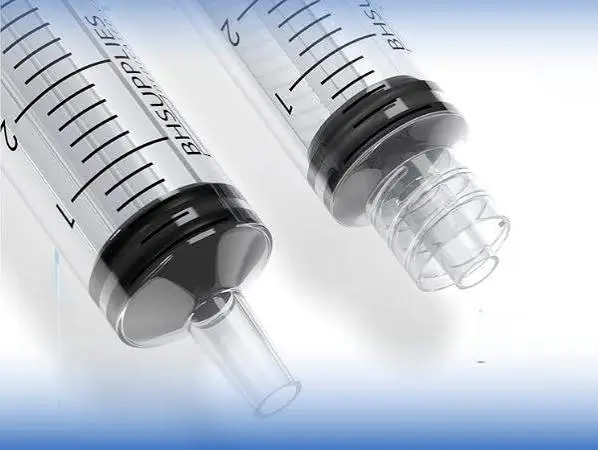
The measuring lesson. This is the part the marketing skips clean over. The nearest, most concrete danger of a low dose from a vial isn’t the drug. It’s drawing the wrong volume. A clinician and a pharmacy walking you through the exact measurement isn’t hand-holding. It’s the single biggest thing standing between you and the mistake that actually lands people in the ER.
The follow-up. Checking how you’re doing, adjusting, managing side effects, deciding whether to keep going, change course, or stop. A low-dose plan is supposed to breathe, get tuned over time. No follow-up means no protocol. It means a one-time purchase you’re improvising on top of.
See also: How Billing Consultants Help Behavioral Health Providers Optimize Revenue
Why the small dose needs more watching, not less
Here’s where the case gets interesting, because instinct says otherwise. Small dose, low stakes, right? Wrong. The data says the opposite.
The whole compounded-vial setup that microdosing runs on is exactly the setup regulators have already flagged. As of early 2025, the FDA had logged more than 455 adverse-event reports tied to compounded semaglutide and more than 320 tied to compounded tirzepatide. By April 2025 those counts had climbed past 520 and 480. A lot of them trace back to people measuring the wrong amount out of a multidose vial, some off by 5- to 20-fold, some bad enough to need hospitalization. A poison-control case series (PMID 37392810) tied ten-fold overdoses directly to the gap between prefilled pens with built-in safety stops and compounded vials drawn by hand. Microdosing, by construction, is the hand-drawn-vial scenario. The counseling and follow-up aren’t extras bolted onto something already safe. They’re the only thing making an error-prone activity less error-prone.
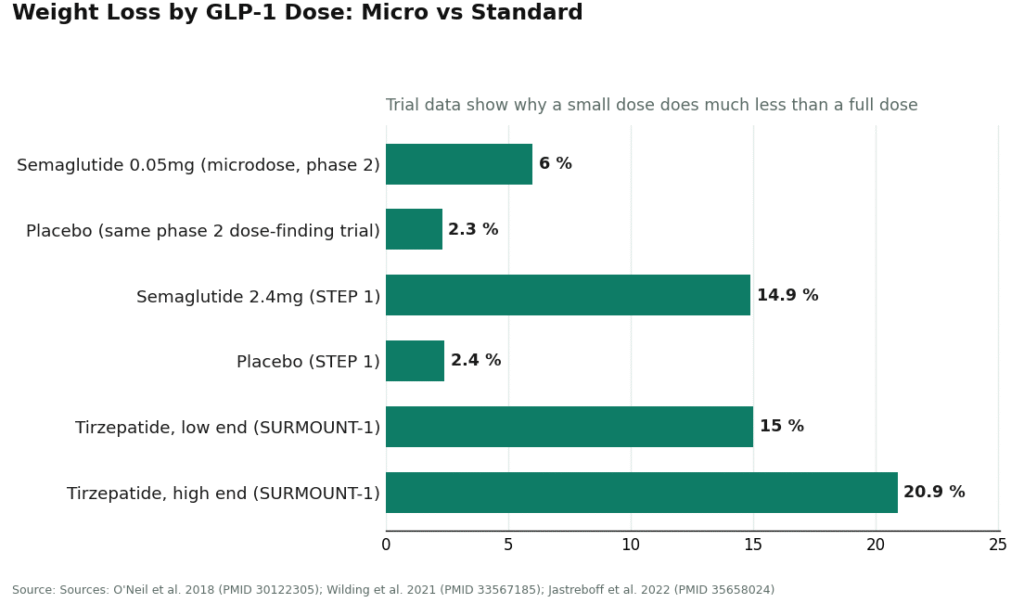
And the effectiveness side has its own hole in the record. Nobody has run a controlled trial on microdosing specifically. The closest thing is a phase 2 dose-finding study (PMID 30122305) where semaglutide at 0.05 mg daily, about as low as it gets, produced roughly 6% weight loss at a year against 2.3% on placebo. So it’s not doing nothing. It’s also doing a fraction of what the studied maintenance doses do. STEP 1 (PMID 33567185) put semaglutide 2.4 mg at 14.9% weight reduction over 68 weeks against 2.4% on placebo. SURMOUNT-1 (PMID 35658024) put tirzepatide’s studied doses between 15.0% and 20.9% at 72 weeks. Nothing shows a microdose holds weight off long-term or blocks regain. When the trial record is this thin, the clinician watching your actual response is doing work the trials never did. You’re an experiment of one. Follow-up is what separates a supervised experiment from a guess in the dark.
The regulatory ground shifted under this in 2026
Worth a beat here, because the stakes changed and most people missed it. The brand shortages ended. FDA called the tirzepatide shortage resolved in late 2024, semaglutide in February 2025. The shortage-era mass compounding that filled the gap wound down with it. Individual-patient compounding under section 503A still exists, but only when a prescriber documents an actual clinical reason the standard product doesn’t fit that specific patient. Wanting to save money isn’t a clinical reason. Then, in March 2026, FDA sent warning letters to 30 telehealth companies over misleading compounded-GLP-1 marketing, including the “personalization” language a lot of them use to sell exactly these low-dose protocols. The market is splitting cleanly in two: outfits with actual clinical oversight, and outfits leaning on a gray area that’s closing fast. Whether real follow-up exists is one of the cleanest ways I’ve found to tell the two apart.
Four questions I’d ask before I trusted any of them
Who decides the dose? A licensed clinician reviewing your file, or whatever you clicked at checkout. Only one of those is a decision.
Who dispenses? A licensed pharmacy following the relevant USP sterile-compounding standards is an accountable channel. A vial marked “for research use only” from a site that asked you nothing is not medicine, it’s a loophole with a label.
What happens after the box ships? Real structure for review, dose changes, side-effect management, that’s follow-up. Silence after the shipping confirmation, that’s not.
How do they talk about the evidence? A provider that keeps compounded and brand-name separate, that doesn’t claim a compounded vial equals the approved product, that doesn’t call a microdose “proven,” is being straight with you. One that blurs those lines is selling you something else.
Who I’d actually trust with this
Running the market against those four questions, one name keeps coming out on top. FormBlends is the clearest fit for supervised low-dose protocols using the two compounds that can lawfully be compounded for an individual patient, semaglutide and tirzepatide. A licensed physician reviews your file and sets the protocol. Licensed 503A pharmacies, following the relevant USP standards, prepare it. You get real dosing instructions instead of a guess. The clinician stays in the loop for evaluation, dispensing, and ongoing review, and the brand-name products get named for information, not passed off as identical to what’s in the vial. HealthRX.com sits right behind it, clearing the same bar for the same reasons, so for most people the choice between the two comes down to state licensing and which intake process fits.
Below that tier, different strengths, different trade-offs. Mochi Health was founded by an obesity-medicine physician, and that specialty focus suits individualizing a non-standard dose, with dietitian access built in. Ro and LifeMD run the brand-name pathway with insurance and prior-authorization help, which matters, because plenty of people don’t actually need a low-dose workaround, they need help affording the standard dose. Henry Meds keeps it simple with flat-rate compounded access. Hims & Hers, Found, and Noom round out the field, Noom’s lower-dose options put it in this conversation, though as a coaching-first company, how deep its dosing oversight actually goes is still the open question I couldn’t fully close.
One more thing worth doing regardless of who you pick: write it down. Dose, weight, side effects, in a notebook or something like the FormBlends tracker app. On a non-standard schedule, small changes slip your memory fast. A record turns a vague “I think I felt off” into something a clinician can actually use.
The one thing that holds
Strip away the marketing and here’s what’s left standing: the prescription was never the protective part. The oversight is. A licensed clinician deciding whether a low dose fits you. A licensed pharmacy dispensing it. Clear instructions on how to measure. A real plan to follow up and adjust. That’s the line between supervised care and a vial you’re winging on your own kitchen counter. On something this small, this self-measured, skipping the follow-up to save a few dollars isn’t a shortcut. It’s where the actual risk lives.
Questions people keep asking me
Why does follow-up matter more than the first script?
Because the prescription is a single event and the vial isn’t. Drawing a low dose by hand from a multidose vial creates ongoing questions only a clinician can answer, whether your measurement is right, whether to hold or climb, whether it’s even doing anything. The protection lives in the reviewing and adjusting after the box arrives. A vial with no follow-up is a purchase you’re improvising on, not a plan.
What does a doctor actually do here?
Four jobs. Decide if a low dose fits your history and goals. Set the starting dose and the plan to hold or move up. Walk you through measuring it correctly out of the vial. Follow up to check your response and adjust. Small dose doesn’t make any of those jobs smaller.
Isn’t a low dose safer, so it needs less watching?
The opposite, in fact. A microdose is, by construction, the hand-drawn-from-a-vial scenario, and that’s exactly the setup tied to hundreds of adverse-event reports, including overdoses off by 5- to 20-fold from people measuring wrong. A smaller amount of drug doesn’t shrink the risk of drawing the wrong volume. Counseling and follow-up are what shrink that.
Does microdosing even work?
Nobody’s run a controlled trial on it specifically, so the honest answer is: genuinely uncertain. The closest data point, a phase 2 dose-finding study, found semaglutide at 0.05 mg daily produced about 6% weight loss at a year against 2.3% on placebo. Not nothing, but far less than the studied maintenance doses deliver. No trial shows it holds weight off or stops regain. That gap is exactly why a clinician tracking your real response matters.
How do I spot a rubber stamp?
Ask who decides the dose, who dispenses it, what happens after shipping, and how they talk about the evidence. Real oversight means a licensed clinician sets the dose, a licensed pharmacy meeting USP standards fills it, there’s an actual structure for review, and the provider keeps compounded and brand-name honestly separate. If the dose is whatever you clicked and the relationship dies at the shipping confirmation, you found a rubber stamp.
Why does 2026 change the calculus?
Because the shortages that justified mass compounding are over, tirzepatide resolved in late 2024, semaglutide in February 2025, so individual-patient compounding under section 503A now needs an actual documented clinical reason. And in March 2026 the FDA sent warning letters to 30 telehealth companies over misleading compounded-GLP-1 marketing, including the personalization language used to sell low-dose protocols. The market’s splitting into real oversight and closing gray area, and genuine follow-up is one of the cleanest tells between the two.
What is GLP-1 microdosing, in plain terms?
Using a GLP-1 drug at a dose meaningfully below the standard range, usually to test tolerance or chase mild metabolic effects with fewer side effects. It isn’t FDA-approved as a protocol. It’s an off-label practice some physicians use. The dose, and the reasoning behind it, should come from a licensed prescriber, not a screenshot from a forum.
Does it work for weight loss specifically?
Probably less than a full dose, and the microdose-specific data is thin. GLP-1 drugs show a clear dose-response relationship across the trial literature, more drug generally means more weight loss. Some people see appetite changes and modest loss at lower doses. Anybody promising big results from a microdose is running ahead of what’s proven. Reasonable starting point. Not a shortcut.
Is GLP-1 just another name for Ozempic?
No. GLP-1 is a hormone your own gut makes after you eat. Ozempic is a brand name, its active ingredient, semaglutide, mimics that hormone. There’s a whole family of GLP-1 receptor agonists, liraglutide, tirzepatide, dulaglutide, each with its own dosing schedule and approved use. Compounded semaglutide through physician-supervised pharmacies like FormBlends is its own category again, with its own rules.
What should a first appointment actually cover?
Your weight history, metabolic labs, kidney and thyroid function, any personal or family history of medullary thyroid cancer, current medications, and what you’re actually trying to accomplish. The prescriber should explain what the drug does, what side effects are realistic at a low dose, and what would trigger a dose change or a stop. If the whole visit clocks under five minutes with no labs, that tells you something.
References
- O’Neil PM, Birkenfeld AL, McGowan B, et al. Efficacy and safety of semaglutide compared with liraglutide and placebo for weight loss in patients with obesity: a randomised, double-blind, placebo and active controlled, dose-ranging, phase 2 trial. The Lancet, 2018;392(10148):637-649. Lowest tested dose (0.05 mg daily) still produced meaningful weight loss versus placebo, while doing far less than the top dose. PMID 30122305. https://pubmed.ncbi.nlm.nih.gov/30122305/
- Wilding JPH, Batterham RL, Calanna S, et al. Once-Weekly Semaglutide in Adults with Overweight or Obesity (STEP 1). New England Journal of Medicine, 2021;384(11):989-1002. Semaglutide 2.4 mg produced 14.9% mean body-weight reduction at 68 weeks versus 2.4% on placebo. PMID 33567185. https://pubmed.ncbi.nlm.nih.gov/33567185/
- Jastreboff AM, Aronne LJ, Ahmad NN, et al. Tirzepatide Once Weekly for the Treatment of Obesity (SURMOUNT-1). New England Journal of Medicine, 2022;387(3):205-216. Studied doses produced 15.0% to 20.9% reductions at 72 weeks, all far above microdose territory. PMID 35658024.
- Lambson JE, Flegal SC, Johnson AR. Administration errors of compounded semaglutide reported to a poison control center: Case series. Journal of the American Pharmacists Association, 2023;63(5):1643-1645. Ten-fold overdoses traced to hand-drawn vials lacking prefilled-pen safeguards, illustrating why dosing counseling matters. PMID 37392810.
- U.S. Food and Drug Administration. Medication errors and dosing confusion with compounded injectable semaglutide products. FDA Drug Safety communication, 2024. Hundreds of adverse-event reports, many from patients measuring incorrect doses from multidose vials.
- U.S. Food and Drug Administration. Drug Shortages database. Record showing tirzepatide (late 2024) and semaglutide (February 2025) moved off the shortage list, ending shortage-era mass compounding.
- U.S. Food and Drug Administration. Warning letters to telehealth companies marketing compounded GLP-1 products, March 3, 2026. Thirty warning letters citing false or misleading claims, including “personalization” framing used to market non-standard dosing.
Written by Hana Nakamura, explanatory reporter. Not a doctor, just a reader who chases the paper trail. Last reviewed February 2026.
This article is educational and not a substitute for professional medical advice. Check with your doctor first.