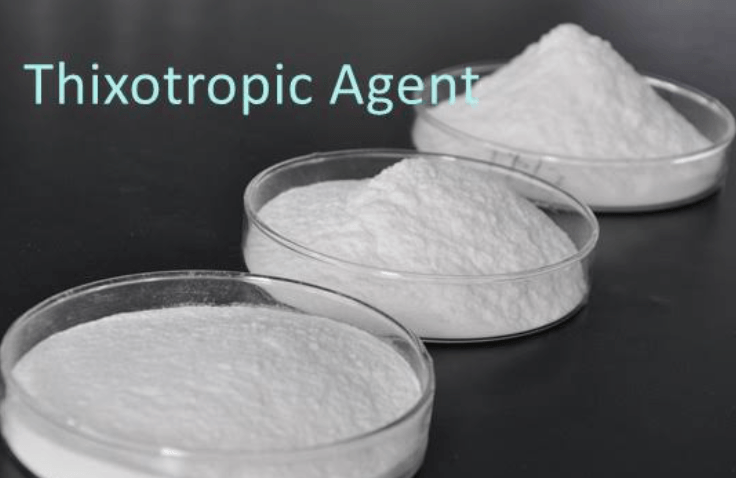

Anyone who has watched a well-formulated paint apply smoothly under a brush, only to stay put on a vertical surface without dripping, has witnessed thixotropic behavior in action. This property, central to countless coating, adhesive, and sealant formulations, depends heavily on the inclusion of an effective thixotropic agent. Fumed silica has long stood out as one of the most reliable materials for achieving this specific type of controlled flow behavior.
What Thixotropy Actually Means
Thixotropy refers to a time-dependent, shear-thinning behavior where a material’s viscosity decreases under applied stress, such as stirring, brushing, or pumping, and then gradually recovers once that stress is removed. This is distinct from simple shear-thinning, which does not necessarily involve the time-dependent recovery aspect that defines true thixotropic systems. A well-designed thixotropic agent enables a formulation to flow easily during application while quickly regaining sufficient viscosity to resist sagging, dripping, or settling once application stress is removed.
This behavior is particularly valuable in coatings applied to vertical or overhead surfaces, where a formulation that remains too fluid after application would simply run or sag before curing, compromising both appearance and film thickness uniformity.
The Physical Basis of Thixotropic Behavior in Fumed Silica
Fumed silica achieves its thixotropic effect through the formation of a loose, reversible network of particles held together by hydrogen bonding between surface silanol groups. Under shear, this network temporarily breaks down, allowing particles and surrounding liquid to flow more freely. Once shear is removed, the silanol groups reform hydrogen bonds between adjacent particles, gradually rebuilding the network structure and restoring higher viscosity.
Comparing Fumed Silica to Other Thixotropic Agents
While various materials can provide thixotropic behavior, including certain clay-based additives and some polymeric thickeners, fumed silica offers particular advantages in terms of formulation versatility, since it functions effectively across a wide range of resin systems and can be selected in hydrophilic or hydrophobic grades to match different polarity requirements. This flexibility makes it a preferred choice across industries ranging from industrial coatings to specialty adhesives.
Recovery Speed as a Critical Performance Parameter
Not all thixotropic agents rebuild their network structure at the same rate after shear is removed. This recovery speed is a critical performance parameter, since a formulation that rebuilds viscosity too slowly may still sag before adequate structure is restored, while excessively fast recovery could interfere with proper leveling and smooth film formation immediately after application. Formulators often need to fine-tune fumed silica loading and grade selection to achieve an optimal balance for their specific application method.
Application-Specific Thixotropic Requirements
Different application methods place different demands on a thixotropic agent’s performance profile. Brush-applied coatings, for example, generally require a somewhat different rheological recovery profile compared to spray-applied systems, given the different shear forces and application speeds involved. Understanding these application-specific requirements helps guide both grade selection and loading level decisions during formulation development.
A more detailed technical discussion of how fumed silica functions as a thixotropic agent, including guidance on optimizing its performance for specific application methods, is available in this resource on thixotropic agent technology, which explores the underlying network mechanics in greater depth.
Testing and Verifying Thixotropic Performance
Evaluating thixotropic performance typically involves rheological testing that measures viscosity under varying shear rates, along with recovery time assessment after shear removal. These measurements provide formulators with objective data to compare different thixotropic agent options and confirm that a selected grade and loading level achieve the desired balance of application ease and post-application stability.
Frequently Asked Questions
How is thixotropic behavior different from simple viscosity increase? Simple viscosity increase provides consistent thickness regardless of applied stress, while thixotropic behavior specifically involves temporary thinning under shear followed by structural recovery once that shear is removed, providing both good flow during application and stability afterward.
Can thixotropic agent performance be affected by temperature? Yes, temperature can influence both the initial viscosity and the rate of structural recovery, so formulators working across variable climate conditions should account for this in their testing and formulation development process.
Is more thixotropic agent always better for sag resistance? Not necessarily; excessive loading can lead to overly thick formulations that are difficult to apply smoothly, potentially causing surface defects, which is why finding the optimal balance through testing is generally recommended rather than maximizing addition levels.
See also: How to Create a Winning Business Plan
Conclusion
A well-selected thixotropic agent plays a fundamental role in balancing application ease with post-application stability across countless coating, adhesive, and sealant formulations. Fumed silica’s reversible network-forming mechanism makes it a particularly versatile choice for achieving this balance, provided formulators take the time to optimize grade selection and loading level for their specific application requirements.