
Resurfacing a sound twenty-year-old plaster shell costs less over ten years than patching it does. Most quotes for pool remodeling cape coral fl land between $8,000 and $15,000 on a pool of that age. That number stings the first time you read it. It stings less than the fourth acid wash, the second round of spot plaster, and the pump you swapped because the chemistry never held. So here is the arithmetic, walked the way an owner reads a bid sheet.
Patch Jobs Cost More Than One Resurface
Plaster is a wear surface with a service life, not a permanent part of the pool. Twenty years in, it goes chalky, rough underfoot, and stained in the low spots the brush never reaches. Patching buys a season, nothing more. Say a spot repair runs $600, an acid wash $450, and a stain treatment $300, repeated in some order every eighteen months, and ten years of that is roughly $8,500 spent to end up beside the same tired finish. A resurface priced right costs less per year than the patch cycle it ends. You are renting a fix, not buying one.
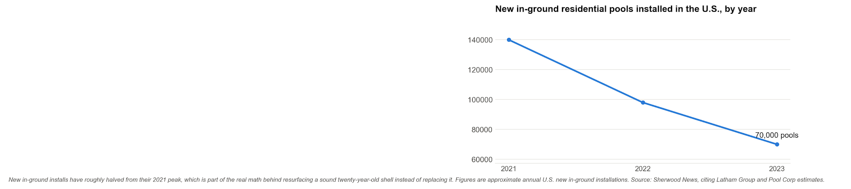
Replacement is also less of a default than it looks from the driveway. New in-ground construction has fallen off hard since its 2021 peak, and crews who used to dig now take renovation work. A sound shell is worth keeping.
What A Full Resurface Actually Includes
A resurface is a sequence, not a product. Crews chip out the failed plaster, replace loose waterline tile, repair hollow spots in the gunite, then apply the new finish. A two-week water chemistry startup follows. Tile alone often adds $1,500 to $3,000 on a pool this old, because the original tile is long discontinued. Drain and haul, permit fees and startup chemicals usually hide inside one line item.
The pool sits empty and open for a week or more, and homeowners underestimate that part. Keep the barrier standing and the gate self-latching for the entire job. Never leave a child near an open work site unsupervised. A 2024 Injury Epidemiology study of 234 fatal drownings among California children ages one to four found pools the most common site, at 65 percent. Construction does not pause that risk.
Finish Choices Move The Final Number Most
Finish is where the spread lives. White plaster is the cheapest route back into the water, and on a 600 square foot interior it is usually the low bid. A quartz blend costs more and buys a harder surface that shrugs off the staining our water leaves behind. Pebble costs the most and lasts the longest, though plenty of owners find it rough underfoot.
Run the cost per year instead of the sticker. Say white plaster comes in at $8,000 with a realistic ten-year life, so call it $800 a year. A quartz finish at $11,500 that holds fifteen years works out near $767. Pebble at $15,000 across twenty years lands around $750, and it is still the biggest check on the job. The gap between those per-year figures is far smaller than the gap between the quotes, which is the single most useful thing to understand before anybody starts chipping.
What we see most often is a sound shell carrying a finish that has reached the end of its life. Owners in that spot fixate on the upfront number and forget the warranty. Ask what the finish warranty covers, and whether labor is included or only material. Ask who handles the startup, by name. A pebble job with a botched two-week startup will mottle no matter what the material cost, and the crew that answers those two questions cleanly is usually the crew that has done a hundred of these.
See also: How to Create a Winning Business Plan
Why Material Prices Kept Climbing Lately
Two forces push the finish number up, and neither is your contractor being greedy. Cement-based finishes track construction demand, and labor has climbed faster than the bagged goods. Florida holds the deepest pool market in the country at roughly 1.56 million pools, by Pool Magazine’s 2026 read of the industry. So every crew here works against a renovation backlog that never really empties.
Service economics tell the same story from the other side. A June 2026 pricing benchmark report from PoolDial pegged median monthly revenue on a revenue-qualified service route at $16,800. Route revenue sets what a good technician earns. Renovation crews get hired out of that same labor pool. When routes pay well, resurfacing labor does not get cheaper.
Where Remodel Budgets Quietly Overrun
The overruns are predictable, which means you can ask about them in advance. Hollow gunite found after chip-out is the usual one, and repairing a bad section can add $500 to $1,500. No bid could have promised otherwise. Original pumps and heaters are cheapest to replace during a resurface, because the pool is already drained.
Verify the contractor before any of that starts. Florida runs a free license lookup through the DBPR licensee search, and ninety seconds there confirms a license is active. Permit requirements vary by scope and by city, so ask the Cape Coral building department what your job needs before work starts.
Pricing A Remodel That Pays Off
Line the scopes up before you line the prices up. When you compare pool remodeling cape coral fl quotes, the cheap bid and the expensive bid often describe different jobs. The difference is usually tile, startup, and whether hollow-spot repair is included or billed later. Ask every contractor to price the same scope, then divide by the expected life of the finish. On a twenty-year-old pool that has already absorbed three or four repairs, one full resurface wins that division. The pool you get back is the one you would have built.