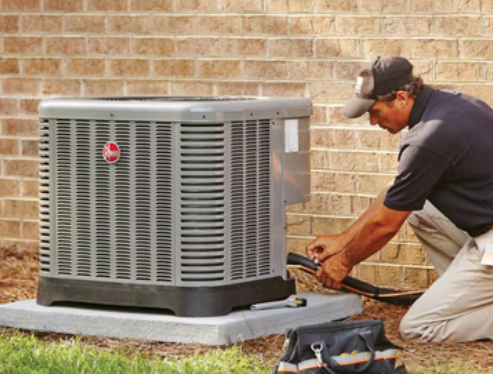

The brand badge on the condenser matters far less than most new homeowners believe. Builders working the master planned subdivisions around Lakewood Ranch buy cooling equipment the way they buy carpet, in volume and at a price. Sizing comes off a rough square footage rule that ignores how a two story house with west facing glass actually behaves in August. That system passes inspection on closing day. Eight years later it short cycles, the air feels damp at 74 degrees, and the owner assumes they simply drew a bad brand.
Sizing was the real problem, and it decides whether the air conditioner installation lakewood ranch fl homeowners pay for lasts fifteen years or falls apart in eight. This is a buyer’s guide for anyone holding two or three replacement bids with very different numbers on them. The argument is plain: a correctly sized system, commissioned properly and matched to Florida’s moisture load, outperforms a bigger brand name bought on price.
Oversized Units Short Cycle In Humid Homes
Short cycling is what an oversized system does when it cools the air quickly and never runs long enough to dry it. The compressor fires, drives the temperature down in six or seven minutes, and shuts off before the coil has been cold long enough to pull real water out. You end up at 75 degrees and 62 percent relative humidity, which feels considerably worse than 78 degrees and 48 percent. The case we see most often in these newer subdivisions is a unit a half ton too large for the actual load. The extra capacity cost the builder almost nothing and read well on a spec sheet.
There is a quick field test you can run yourself. If the unit cycles more than three times an hour on a 92 degree afternoon and your indoor humidity sits above 55 percent, the box is too big for the house. If it runs forty minutes straight and the thermostat still drifts upward, it is undersized, and the duct system is usually the second half of that story. Either way the compressor pays for it, because startup is where most of the wear happens.
Load Math Matters More Than Brand Names
A load calculation, what the trade calls a Manual J, adds up the heat actually entering your house: glass area and orientation, insulation, ceiling height, duct losses, how many people live there. It is arithmetic rather than opinion, and a competent estimator can finish one in about an hour on a subdivision floor plan. Two houses on the same street with identical square footage can land a half ton apart because one faces west. Florida humidity does not negotiate, and the latent load, the moisture portion of the job, is where builder math usually goes wrong.
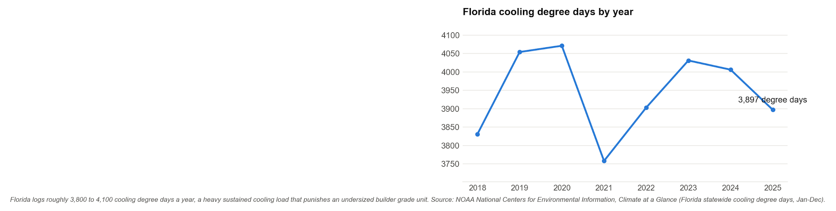
The load on that equipment is also creeping upward each decade. A May 2026 study in Nature Communications reported that American population exposure to dangerous extreme heat, measured as a wet bulb globe temperature above 32C, has climbed 21 percent since the 1940s. Equipment chosen for the summers of a decade ago is being asked to hold a line in hotter ones. None of that is an argument for oversizing the replacement. It argues for sizing correctly and letting a staged system run longer at lower capacity, which is how moisture actually leaves a house.
Questions To Ask Before Signing An Install Bid
A full changeout in a 2,100 square foot subdivision home around here tends to land somewhere between six and nine thousand dollars. The spread inside that range is mostly labor, ductwork, and whether anybody did the math. Call it $7,400 for a straight three ton swap. Honestly, closer to $8,600 once a properly sized return, a new line set, and the county permit land on the invoice, and the cheapest bid on your counter probably skipped all three. Ask about them before you sign, not after the crew is standing in your garage.
- Will you run a room by room Manual J load calculation, or size off the old unit? A good answer comes with a printed report you get to keep.
- What indoor humidity will this system hold on a 92 degree afternoon? Anything under 55 percent is a real answer, and “it will be comfortable” is not.
- Did you measure static pressure on the existing returns and supply trunks? A good answer names the number they read and what it should be.
- Who pays for labor if the compressor fails in year six? A good answer separates the parts warranty from the labor warranty, in writing.
The answers matter less than whether the contractor already has them ready. A crew that measures static pressure before quoting is a crew that has been burned by a strangled duct system and does not want the callback. Vague answers about sizing tend to reappear later as a change order, priced at a moment when you have no leverage left.
See also: How to Create a Winning Business Plan
Pick An Installer Who Sizes For Humidity
The installers worth hiring are already busy. The Air-Conditioning, Heating, and Refrigeration Institute logged 523,132 air conditioner shipments in May 2026, up 10.2 percent from the same month a year earlier. That says plenty about how much equipment is moving and how thinly the skilled labor behind it is spread. Wait until the first genuinely hot week to start calling and you will be choosing from whoever answers the phone, not from whoever measures.
Any bid for air conditioner installation lakewood ranch fl homeowners should take seriously opens with a load calculation and ends with a commissioning report showing measured airflow and refrigerant charge. Those two documents separate a system still working past year fifteen from a builder grade box that quits in year eight, whatever name is stamped on the side. Keep them with your closing paperwork, because the next owner of that house will be glad you did.